
Which Pirots 5 RTP are you actually comparing?
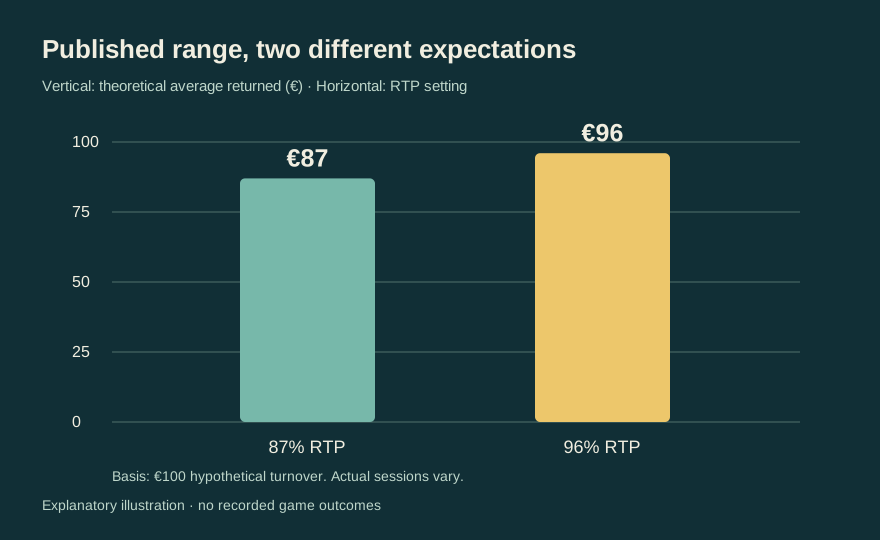
The official Pirots 5 specification lists a return-to-player range of 87–96%, dependent on market and operator. A guide that prints only “96% RTP” drops a material part of that specification. The upper end describes an available published setting, not every client carrying the game name. Check the rules in the exact game you open before treating it as your setting.
RTP is a long-run theoretical ratio between returned money and total stakes under the applicable configuration. It is not a refund promise for a session or a countdown toward a compensating win. At 96%, the corresponding theoretical house edge is 4%; at 87%, it is 13%. The simple subtraction is 100% minus RTP, provided you are using the correct setting and compatible accounting basis.
For a hypothetical €100 of turnover at a 96% setting, the theoretical average returned is €96 and the average loss €4. At 87%, the corresponding figures are €87 and €13. These are expectation calculations across the model, not predictions that a particular €100 session ends at either amount. Short sessions can finish far above or below an average.
Turnover is the total amount wagered, not simply the initial deposit or starting balance. If you stake the same returned euro again, it contributes another euro to turnover. A €20 starting balance can therefore support more than €20 of cumulative wagers before the session ends. Equating starting balance with turnover understates the amount exposed to the game’s mathematical edge.
The gap between 87% and 96% is nine percentage points. Relative to the 4% edge at 96%, a 13% edge is 3.25 times as large. That comparison shows why checking the actual setting matters. It does not establish which setting any named operator uses, and we do not assign the upper figure to our partner route without a verified live listing.
Our official launch attempt received an initialization error before playable controls loaded. The active RTP could not be read from a live paytable. No observed RTP is published here, because zero completed rounds cannot produce a measured return ratio. Published specification, active client setting and an observed sample are three different pieces of information.
7/10 volatility and 25.1% hit frequency answer different questions
ELK rates Pirots 5 volatility at seven out of ten. This is the provider’s scale. It conveys a relatively variable payout profile within that presentation, but it is not a universal unit shared by every studio. Comparing a 7/10 ELK score with a “high” label from another provider does not give a precise ratio of risk.
Volatility concerns how outcomes are spread around an average. Two games can have the same theoretical RTP while returning money in very different patterns. One may give more frequent small awards; another may concentrate a larger share of its theoretical return in rarer events. Knowing the average alone does not tell you how a short session feels or how quickly a small balance might be used.
The product sheet also lists a 25.1% hit frequency. Do not substitute “profitable rounds” for “hits”. A positive return smaller than the amount charged can count as an award while leaving a net loss. Nor should the hit figure be relabelled as the natural bonus frequency. The sheet does not say that roughly one quarter of starts enter a bonus.
For example, consider three hypothetical €1 starts returning €0, €0.20 and €2. The total cost is €3, the total return €2.20 and the net result −€0.80. Two starts produced a positive return, but only one individually returned more than its stake. This tiny invented example explains the counting distinction; it is not a Pirots 5 sample or an estimate of its distribution.
There is another reason to label modes. A €1 base start and a €250 Super Bonus purchase have very different full costs. Counting each as one start can be useful for an event log, but their exposure is not equal. A statistic based on number of starts must sit alongside total stakes, mode and final returns if you want to interpret it responsibly.
We cannot derive a confidence interval, typical losing streak or bonus wait from the four headline numbers alone. Those calculations would require a defined payout distribution or a suitable recorded sample. Attaching a precise-looking probability to an unknown distribution would make the page more numerical without making it more informative.
A return ratio needs the right denominator
For any complete sample, observed return percentage would be total money returned divided by total money charged, multiplied by one hundred. It is not the percentage of entries with a win animation. It is also not the average of individual return percentages when the charges differ. A large purchased feature must contribute its actual stake weight.
Take two invented entries: €1 charged with €2 returned, then €100 charged with €50 returned. Their individual return ratios are 200% and 50%. Averaging those percentages gives 125%, which misrepresents the combined result. The correct combined ratio is €52 divided by €101, about 51.49%, with a net result of −€49.
This exercise shows why a future test must retain the actual debit for every mode. It is not an observed Pirots 5 RTP calculation. No estimate of the game’s true distribution or confidence range follows from the invented pair.
What a 10,000× maximum means at different stakes
The published maximum win is 10,000 times the base stake, with maximum exposure of €1,000,000. At a €100 base stake, multiplying by 10,000 gives €1,000,000. At €1, the same multiplier gives €10,000; at €0.20, it gives €2,000. The million-euro figure belongs with the maximum stake, not every possible purchase.
An upper limit does not state how likely it is to be reached. It also does not state the average size of a bonus. A large cap can be relevant when comparing rules, but it cannot by itself identify a profitable game or justify increasing the stake. We have no measured maximum-win frequency for Pirots 5.
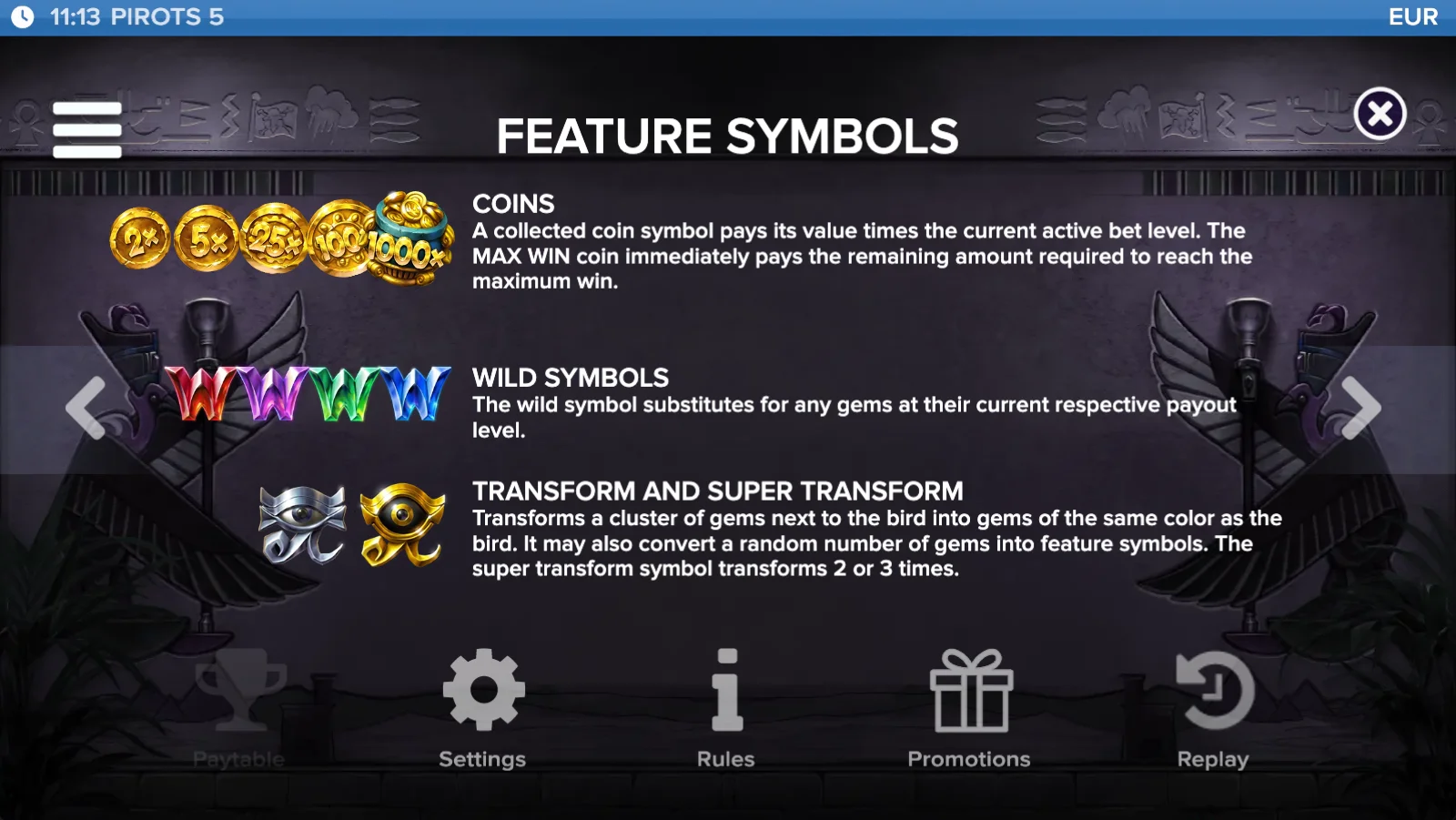
The MAX WIN coin is described as awarding the remaining amount up to the cap. If a result has already accumulated some payout, “remaining” matters. It is not permission to add another whole 10,000× on top of the amount already won. Read the cap as a limit on the applicable total rather than an extra award outside the rules.
Purchase cost also changes how you describe net profit at that ceiling. In a purely arithmetic €1-base example, a €10,000 return after an ordinary €1 charge leaves +€9,999. The same return after a €250 purchase leaves +€9,750. These examples do not assert that every mode has the same chance of the cap or that the cap will occur. They show why returned money and net profit are different columns.
Check currency presentation before converting these examples to a live client. The product sheet permits currency-equivalent stakes. A client displaying another currency may use different allowed increments. A conversion at today’s exchange rate is not proof that the game accepts the resulting decimal amount or applies the same displayed maximum.
The table keeps the base stake and mode charge separate. Its maximum column is multiplication of the published cap, not a forecast. The interactive calculator uses the same separation for ordinary illustrative returns, so you can read a small outcome without being distracted by the largest theoretical number on the page.
Swipe sideways if the table extends beyond the screen.
| Base stake | Base-play charge | Super Bonus charge | 10,000× cap arithmetic |
|---|---|---|---|
| €0.20 | €0.20 | €50 | €2,000 |
| €1 | €1 | €250 | €10,000 |
| €10 | €10 | €2,500 | €100,000 |
| €100 | €100 | €25,000 | €1,000,000 |
Read maximum-win figures together with their stake basis, currency and applicable cap.
Can waiting or raising the stake improve the mathematics?
The documented rules describe collectors, transformations, gem levels and feature triggers. They do not describe a player signal which makes the next paid start favourable. We have not recorded a Pirots 5 sample that supports a waiting rule, a stake increase after losses or a profitable mode-switching system. There is no historical strategy leaderboard on this page because there is no measured history behind one.
Money management can still change a session’s exposure. A fixed cost per attempt makes spending easier to audit. A purchase cap prevents one selected mode from consuming more than the amount you intended to risk. A stop condition can end a session earlier. Those are decisions about how much and how long to play; they do not by themselves change the payout probabilities of the selected game configuration.
Doubling after a loss illustrates the distinction. Starting with €1, the sequence €1, €2, €4, €8 and €16 spends €31 across five losing attempts. A nominally small starting stake can become a large combined debit quickly. Slot awards are not simple fixed even-money wins, so a later positive award need not recover that sequence. We do not present a doubling ladder as a recovery guarantee.
Waiting has an accounting effect only if it means placing fewer paid starts. Watching animations or skipping a period is not evidence that the next start is “due”. Similarly, higher gem levels retained inside an active bonus are documented game state. A belief that yesterday’s losses improve tomorrow’s opening spin is not the same kind of fact.
If a future test evaluates a proposed rule, it should state the rule before the validation sample, preserve full costs and settle attached features. A rule selected because it happened to win on the same data needs a separate forward check. Even a profitable recorded stretch would describe that stretch, not remove the theoretical house edge or guarantee another result.
For now, the usable comparison is the one we can calculate exactly: base stake multiplied by mode price, then final return minus the full debit. It is less dramatic than a secret timing signal, but it catches a real error players can make when a 250× purchase sits beside a €1 stake display. Start with that cost check before considering a staking sequence.
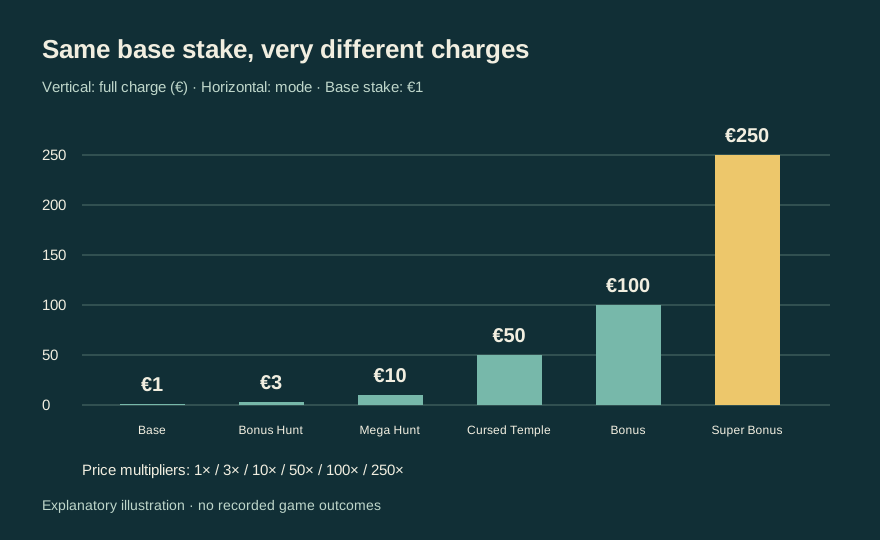
- Base game: 1 €
- Bonus Hunt: 3 €
- Mega Hunt: 10 €
- Cursed Temple: 50 €
- Bonus: 100 €
- Super Bonus: 250 €
What the launch response does—and does not—tell us
The 6 November 2026 inspection opened the Cursed Temple board and Rules. No paid starts or settled rounds were recorded. The help states 96.0% RTP for that demo; an operator’s setting and local network access still require their own check.
The earlier 4 November error produced no paid starts, settled rounds or observed WebSocket frames. The successful 6 November controls inspection is a separate capture. This is a description of that capture, not proof that every successful Pirots 5 session avoids WebSockets. A blocked initialization cannot establish the transport used for later gameplay, results or any optional live feed.
The same distinction applies to speed. The time taken to receive an error is not a round latency or a representative mobile loading benchmark. We have not published a ping league table or claimed that Finnish players will see the same error. Network route, regional eligibility and operator configuration would need to be checked in a genuinely successful launch.
You can still use the documented rules to understand costs, triggers and limits. Treat the demo page as an honest launch check, the illustrated rules as an explanation of the product, and this page as the mathematical interpretation of its published figures. None substitutes for verifying the exact client and terms before using a commercial route.