
Six prices: the base stake is only the starting point
The X-iter panel is the most important place to slow down before a purchase. The base stake is the unit used to price a mode. It is not necessarily the amount deducted when that mode starts. At a €1 base stake, ordinary play costs €1, Bonus Hunt €3, Mega Hunt €10, Cursed Temple €50, Bonus €100 and Super Bonus €250.
That price ladder creates very different exposure from the same displayed base stake. With €50 allocated to a session, one €1-base Cursed Temple purchase uses the full amount. Fifty ordinary €1 starts have the same initial aggregate cost before any returns, but they are not the same distribution of outcomes. Equal spending does not make one feature purchase statistically equivalent to fifty ordinary rounds.
The provider describes Bonus Hunt as giving more than four times the bonus-trigger chance. This is a relative comparison. Without the underlying chance, it cannot tell you a reliable “one bonus every N spins” figure. It also does not mean four guaranteed bonuses or four times the average net profit. The mode costs three base stakes each time.
In the inspected Cursed Temple help, Mega Hunt buys one drop for ten times the selected base bet. The stated bonus-trigger chance is more than twenty times the ordinary chance. This is a relative rule claim, not a measured trigger rate or a guaranteed bonus. Without the underlying probability, it does not give an exact number of drops needed to trigger one.
Bonus and Super Bonus buy entry to their respective features. Entry is what is guaranteed by the purchase description, not profit. Super Bonus advertises coin rain on every bonus drop, but the total still has to be compared with its 250× cost. A visually busy bonus can return less than the amount you paid to enter.
Swipe sideways if the table extends beyond the screen.
| Mode | Cost multiplier | At €0.20 base | At €1 base |
|---|---|---|---|
| Base game | 1× | €0.20 | €1 |
| Bonus Hunt | 3× | €0.60 | €3 |
| Mega Hunt | 10× | €2 | €10 |
| Cursed Temple | 50× | €10 | €50 |
| Bonus | 100× | €20 | €100 |
| Super Bonus | 250× | €50 | €250 |
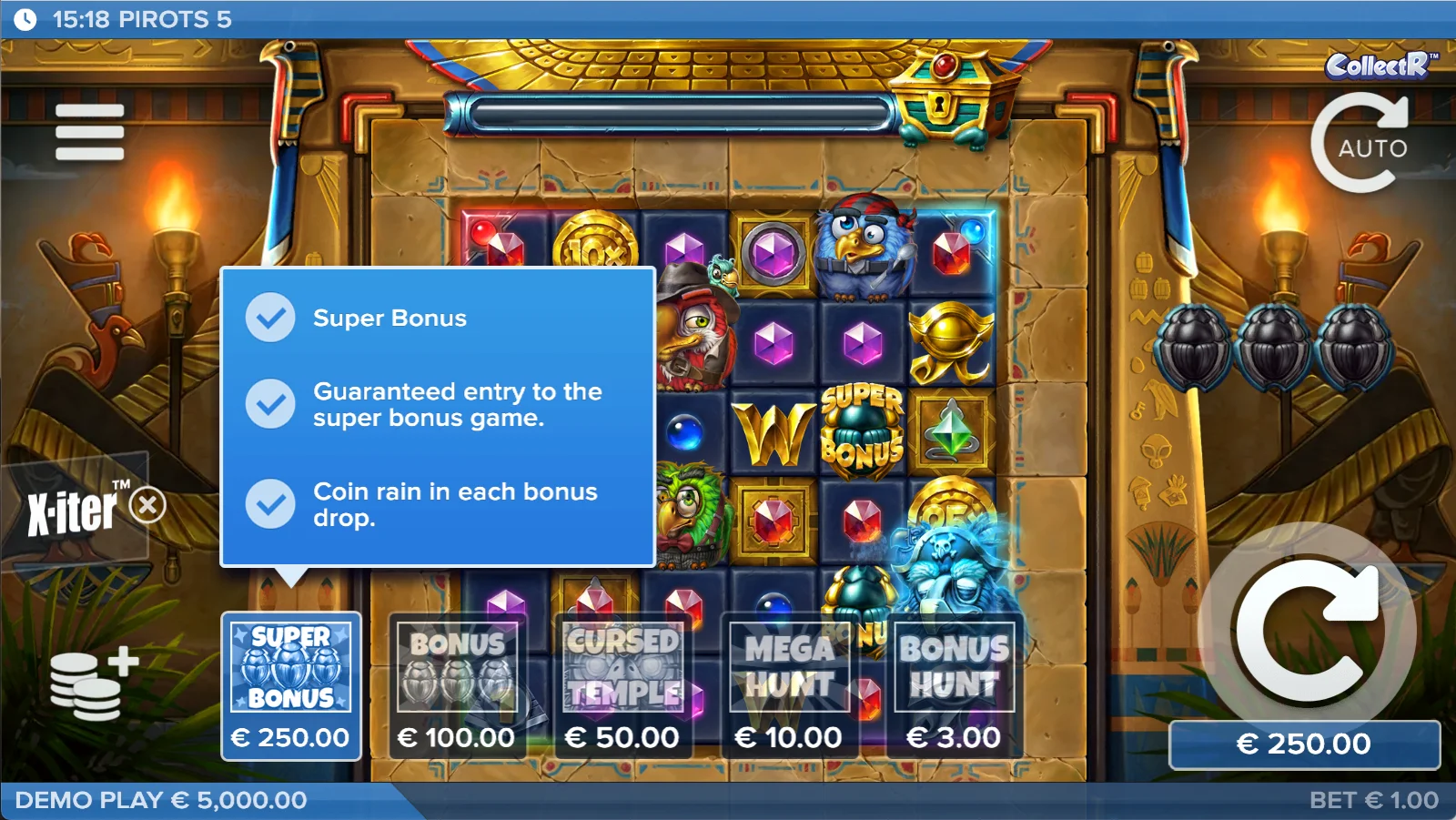
A useful menu check is to say the complete charge aloud before confirming: “This is a fifty-euro purchase at a one-euro base stake.” That sentence forces the two amounts apart and catches a misplaced decimal or forgotten mode multiplier.
Natural entry and purchased entry need separate records
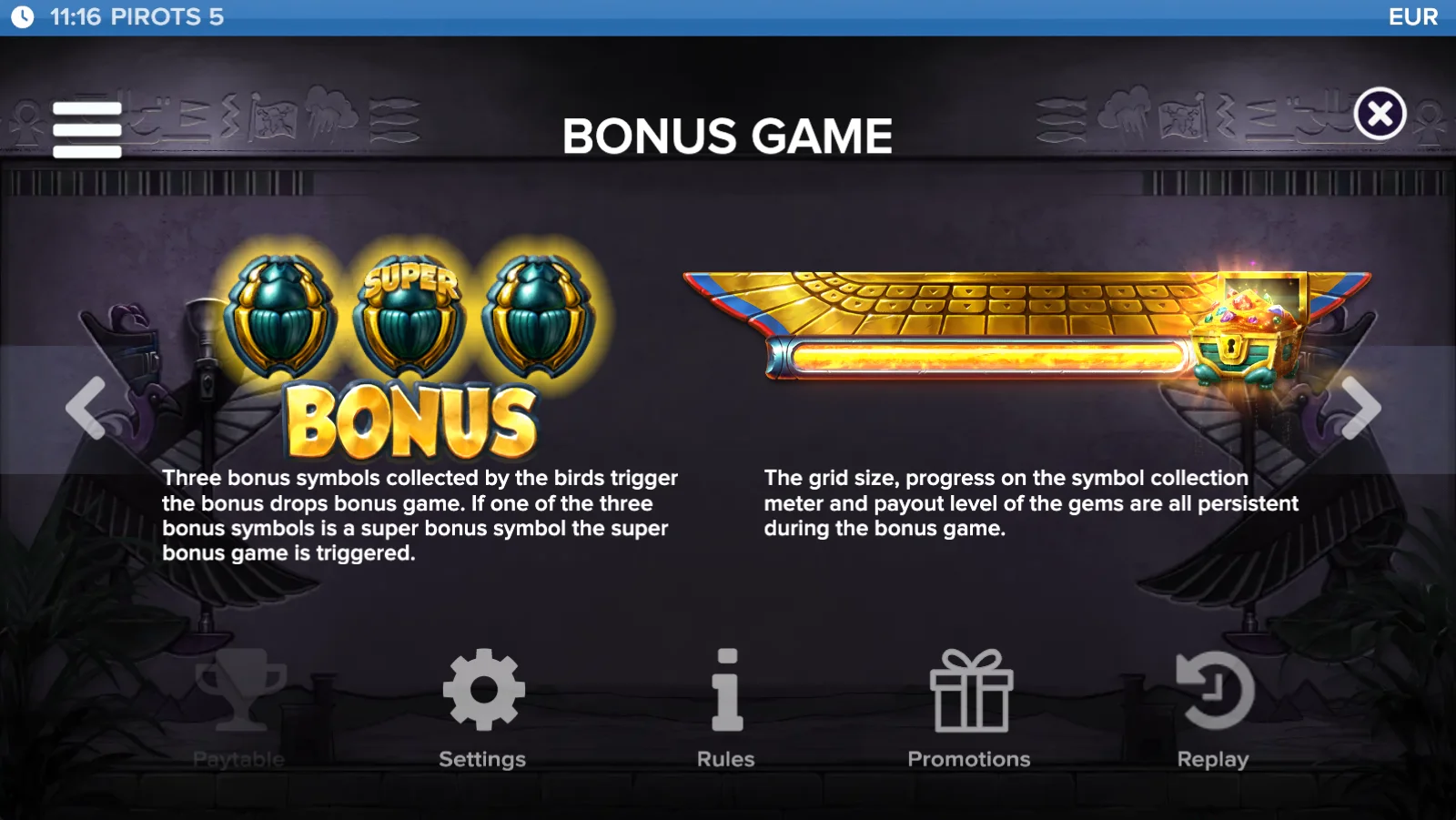
Natural bonus entry is based on collecting three bonus symbols. One Super Bonus symbol among those three changes the entry to Super Bonus. The rule is about the collected symbols; a symbol that is visible but has not been collected does not satisfy the same condition. This is especially easy to miss while several birds are moving.
The bonus keeps three kinds of state: grid size, collection-meter progress and gem payout levels. Keeping those variables within the feature allows its later drops to begin with progress already made. The documentation does not turn that feature state into a permanent account benefit. We would not describe changing stakes or reopening the game as a way to preserve an advantage without direct evidence.
A naturally triggered bonus belongs to its parent paid round. If a €1 start leads into a bonus and the complete sequence returns €12, the hypothetical net result is +€11. It is not twelve euros plus every intermediate counter value. If a €100 purchased bonus returns the same €12, the net is −€88. The animations can resemble one another while the cost basis is completely different.
For that reason, a useful results table needs a mode column, a total-debit column and a final-return column. Counting only “bonuses played” would make those two examples look more comparable than they are. A feature bought for 100× and a feature reached from base play should not be pooled into an unlabeled win-rate claim.
This site has not completed a live Pirots 5 sample. We do not know the natural bonus frequency from our own play, and we do not publish a profitable feature-purchase strategy. The illustrations are still useful for learning the trigger and reading the cost. They simply answer a different question from a measured session.
Cursed Temple: why three drops can become more
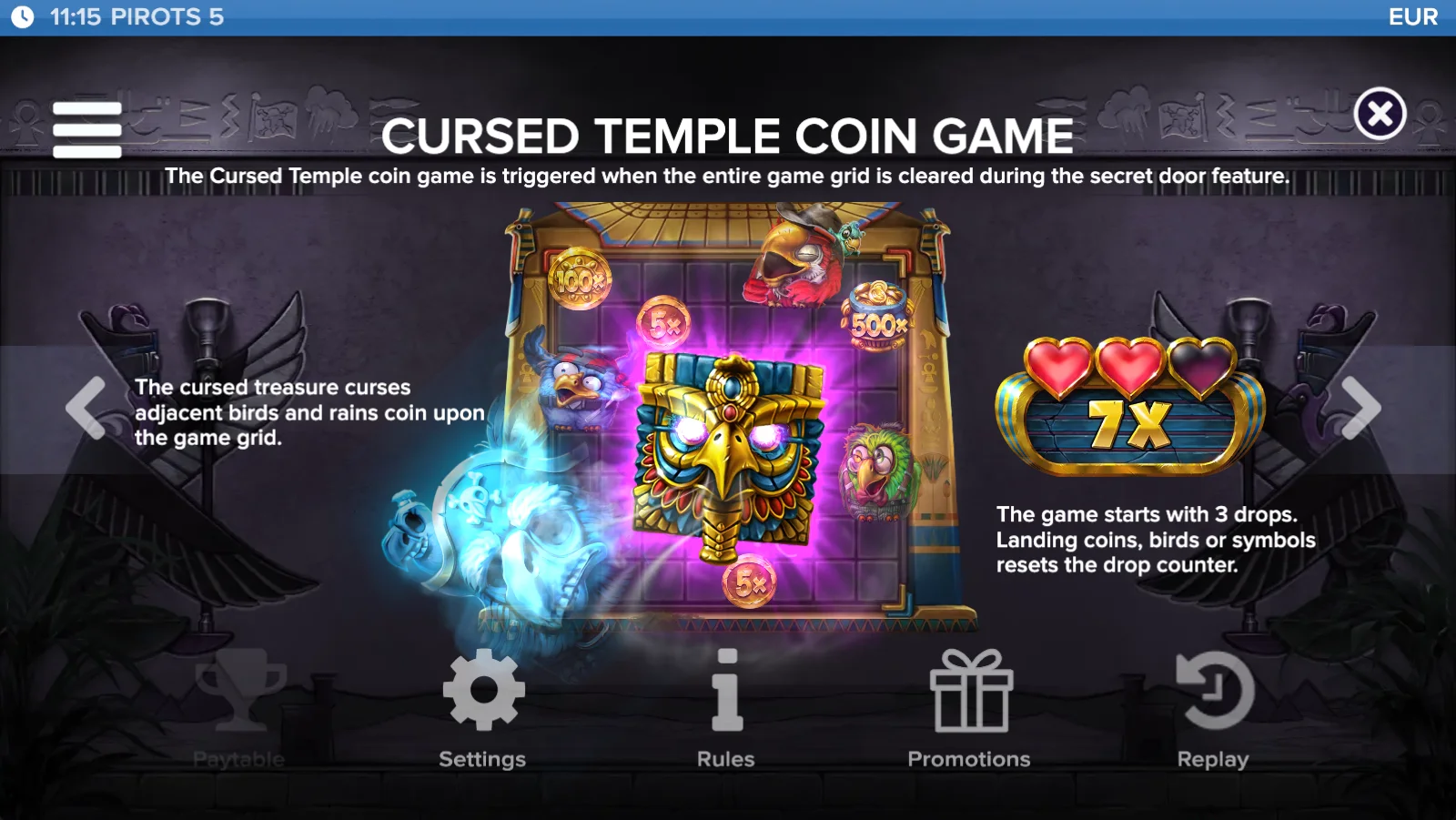
The Cursed Temple coin feature starts with three drops. Coins, birds and other eligible resetting symbols restore the counter when they land. A short starting counter can therefore lead to a longer feature. The duration depends on what happens before the counter runs out, rather than a fixed promise of exactly three results.
Try the counter below. Press “Empty drop” twice: three becomes two, then one. Press the resetting-symbol button while one remains: it returns to three. Now press “Empty drop” three times and the example finishes. Once the counter reaches zero, another hit is not a free continuation of the ended feature; reset the example to start again.
The buttons let you choose every event. They demonstrate the counter rule only. There is no RNG, payout table or probability model behind them. You cannot use a sequence you manually select here as evidence that the real feature will last that long, or as a way to predict when a resetting coin will appear.
Treasure symbols can curse adjacent birds and create coin rain. That is another conditional event within Cursed Temple. Its presence explains a changed board and new awards, but it does not remove the cost of entry from the accounting. A feature that survives several resets can still return less than its purchase price.
Clearing the entire grid during Secret Door is the documented route into Cursed Temple from the collection mechanics. Seeing a door is not the same as completing the clear. Cross-over tiles allow movement through collected positions, which helps explain the visual sequence without implying that the player selects the route.
Try the three-drop counter
An illustration of the Cursed Temple rule. You choose the events; this does not generate wins.
Three drops remain.
Cursed Temple, The Kraken and City of Gold
ELK’s official Pirots 5 materials include Cursed Temple, The Kraken and City of Gold. The sheets share game ID 10266 and OGS ID 110266. The ordinary launch also showed all three names on its world map. Cursed Temple’s board and help were opened first. A separate follow-up then opened The Kraken and City of Gold, without placing bets. A name in a downloadable sheet should not be turned into an invented launch parameter.
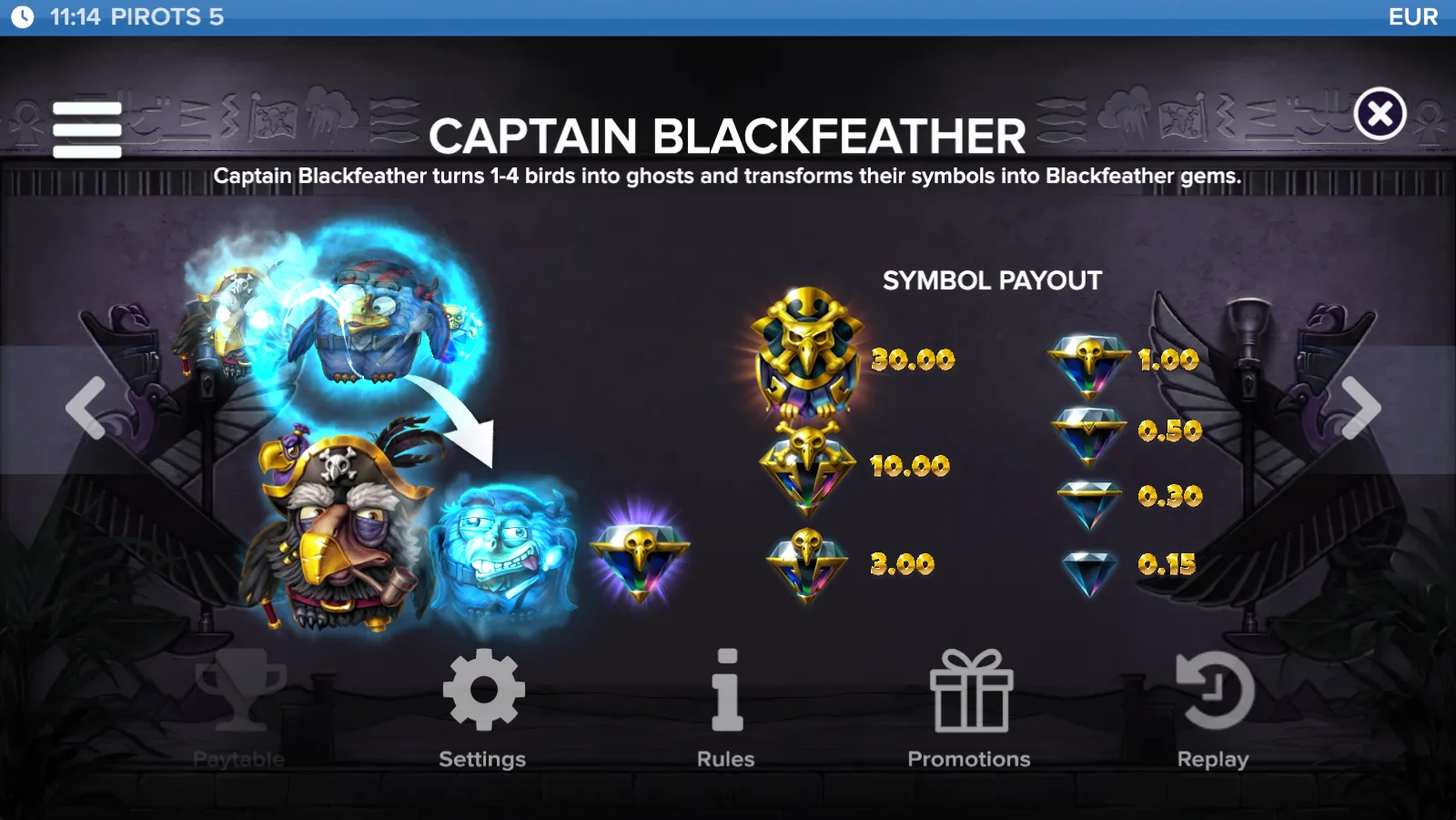
Cursed Temple uses Captain Blackfeather, who changes one to four birds into ghosts and changes their gems accordingly. Its catacomb enemy is a mummy. The coin feature describes cursed birds and coin rain. Those details are useful when you want to identify which rule set or promotional picture you are looking at.
The Kraken material replaces that signature presentation with the Golden Compass Cannon. It changes gems in its firing direction to features and recoils in the opposite direction. The catacomb enemy is a land crab. The Kraken coin feature starts with three drops and describes the same kind of counter reset on eligible landing events.
City of Gold describes a Golden Book, which turns one to four birds and their gems golden. A shaman appears in its catacombs. Its coin feature starts with three drops, and a Mastermind releases minions while fighting birds, producing coin rain. The sheet reviewed here does not explicitly document every reset detail; we do not fill that gap by copying the Cursed Temple wording.
The published mode-price ladder is the same across these three sheets. The named coin feature occupies the 50× position: Cursed Temple, Kraken or City of Gold. Bonus is 100× and Super Bonus 250×. The shared price ladder is useful for cost comparison, but it does not prove identical outcomes or that the operator you visit offers every named variant.
Swipe sideways if the table extends beyond the screen.
| Material | Distinctive feature | Catacomb enemy | Named 50× mode |
|---|---|---|---|
| Cursed Temple | Blackfeather / ghost birds | Mummy | Cursed Temple |
| The Kraken | Golden Compass Cannon | Land crab | Kraken |
| City of Gold | Golden Book / golden birds | Shaman | City of Gold |
A purchase check you can actually repeat
Start with the amount you intend to spend on one complete attempt. Divide it by the mode price multiplier if you want to understand the corresponding base stake. For example, a €20 cost corresponds to a €0.20 base in the 100× Bonus mode. It would require a €0.08 base in the 250× mode, which is below the provider’s published €0.20 minimum. Arithmetic does not create an available stake.
At the published minimum, Super Bonus costs €50. If the client offers that mode and minimum, there is no €20 purchase simply because €20 is your budget. Selecting a different mode changes the game exposure; it is not a hidden discount on the same purchase. The exact range and available features must still be checked in the operator’s client.
Now compare the full return with that full cost. A €50 purchase returning €75 has a hypothetical +€25 net result. A €250 purchase returning €75 has a −€175 net result. Both have the same returned amount and can display the same prominent win number. Only the purchase price tells you which recovered the money spent.
Use the Pirots 5 cost calculator to vary the base stake, mode and illustrative return. The calculator does not recommend the most profitable mode. It makes the debit and break-even amount explicit. No outcome probabilities are inferred from a price multiplier, and an expensive entry does not automatically have a better RTP.
Finally, read the specific paytable and RTP shown in the client you can actually open. The published Pirots 5 range is 87–96%, dependent on market and operator. We have not verified the active setting of a partner listing. A price comparison is complete only when you understand what is being purchased and what remains unknown. The RTP guide explains the numbers without converting them into a session forecast.
Choose the question before comparing two modes
There are at least three different comparisons a player can make, and they should not be merged. The first is equal base stake: compare all prices at €0.20 or €1. This shows the extra charge attached to each mode. It is the comparison in the main price table and the easiest way to notice that the displayed stake is not always the full debit.
The second is equal total cost. A €20 Bonus purchase at a €0.20 base stake can be compared as spending with other attempts whose combined charges are €20. That comparison says nothing about matching outcome distributions. Ten €2 attempts and one €20 attempt divide the exposure differently, even when the arithmetic total is identical.
The third is equal desired feature. Here the question is whether the player is buying entry or waiting for the documented collected-symbol trigger. We know the entry prices and trigger descriptions, but not a verified natural frequency from our own sample. Without that frequency and full return information, there is no justified calculation that one route is cheaper per profitable bonus.
Keep the question visible in any notes or screenshot caption. “This mode costs less” can be true at the same base stake without meaning it has a better long-run return. “This mode enters a feature” can be true without meaning that the feature will cover the price. Both distinctions prevent a price table from becoming an unsupported ranking.
When an operator changes the available stake increments, repeat the comparison using those offered values. Do not force a neat equal-cost example by assuming a missing stake. For a practical first read, choose one published base stake, calculate each full charge and identify the precise feature description. That is enough to understand the menu without inventing a best-performing mode.
Pirots 5 tokens: collect nine to unlock Boss Castle
The collection has three tokens in Cursed Temple, three in The Kraken and three in City of Gold. Collect all nine to unlock Boss Castle permanently under the inspected rules. This is a separate collection from the coloured gems that birds take across the grid.
Tokens can appear during spins. Each of the three tokens within a world has the same hit frequency, but frequencies differ between worlds. Once you have collected a world’s three tokens, that world stops supplying more. The rules give no numerical odds or guaranteed number of spins. A missing token therefore does not tell you that the next round is more likely to supply it.
A collected token pays like a 5× coin. For example, at an active €0.40 bet level, that coin rule means €2 returned. That is a payout example, not €2 of net profit: a selected X-iter mode may cost more than the base bet.
Token progress survives changes of bet level, rounds and game modes. Gem levels and the normal 6 × 6 starting grid follow different reset rules. The Cursed Temple coin game does not award collectible tokens; that exclusion does not remove the three tokens from the Cursed Temple world itself.
Before chasing the collection, check which world still has an empty slot. X-iter modes have different token frequencies, but the rules do not disclose enough numerical rates to calculate the cheapest route to nine tokens. No token award or Boss Castle unlock was recorded in this inspection. The persistence statement also does not verify transfer between operator accounts or devices.
When was Pirots 5 released?
ELK’s launch announcement dates Pirots 5: Cursed Temple to 23 July 2026. Do not assign that date automatically to The Kraken, City of Gold or a particular casino’s lobby launch. The date inside a help file can instead refer to its revision.