
Before your first Pirots 5 round
Pirots 5 is an ELK Studios CollectR slot. Its birds move through gems and feature symbols instead of paying conventional lines across reels. Your first task is to recognise what a bird can collect. Your second is to distinguish the base stake from the amount you are about to spend. Those two checks explain more of the game than searching for a supposedly lucky time to press spin.
The initial board has six rows and six columns: 36 positions. Four colours connect the birds to their gems. A bird collects its own colour and can collect feature symbols. A picture of a large cluster is therefore not enough to calculate a win. Which bird can reach it, the current gem level and the features that change the board all matter.
Choose the stake before starting the paid round. In the provider’s published specification, the euro base-stake range is €0.20–€100, or a currency equivalent. That is a product range, not a promise that every operator exposes every increment. Use the choices actually offered in the game you open. Do not type an unsupported stake into an external calculator and assume the client will accept it.
Next, inspect the selected mode. Base play costs one base stake. The X-iter menu also offers modes priced at 3, 10, 50, 100 and 250 times that stake. A €0.40 base stake therefore costs €0.40 in ordinary play and €100 for Super Bonus. A small number beside “bet” can sit next to a much larger purchase price; read both before confirming.
Let the complete collection sequence settle before judging the outcome. Bird movement, an upgrade and a bonus sequence may be parts of one paid start. Counting each animation as another independently purchased spin makes both your spending record and your return calculation wrong. Keep the amount charged and the final total returned for the entire sequence together.
This guide uses the official Cursed Temple rule images. They are provider illustrations, not our own wins. On 6 November the official launch reached Cursed Temple’s controls and help. No sample of completed Pirots 5 bets has been recorded here. The rules below explain the documented game; they do not turn those illustrations into a personal winning session.
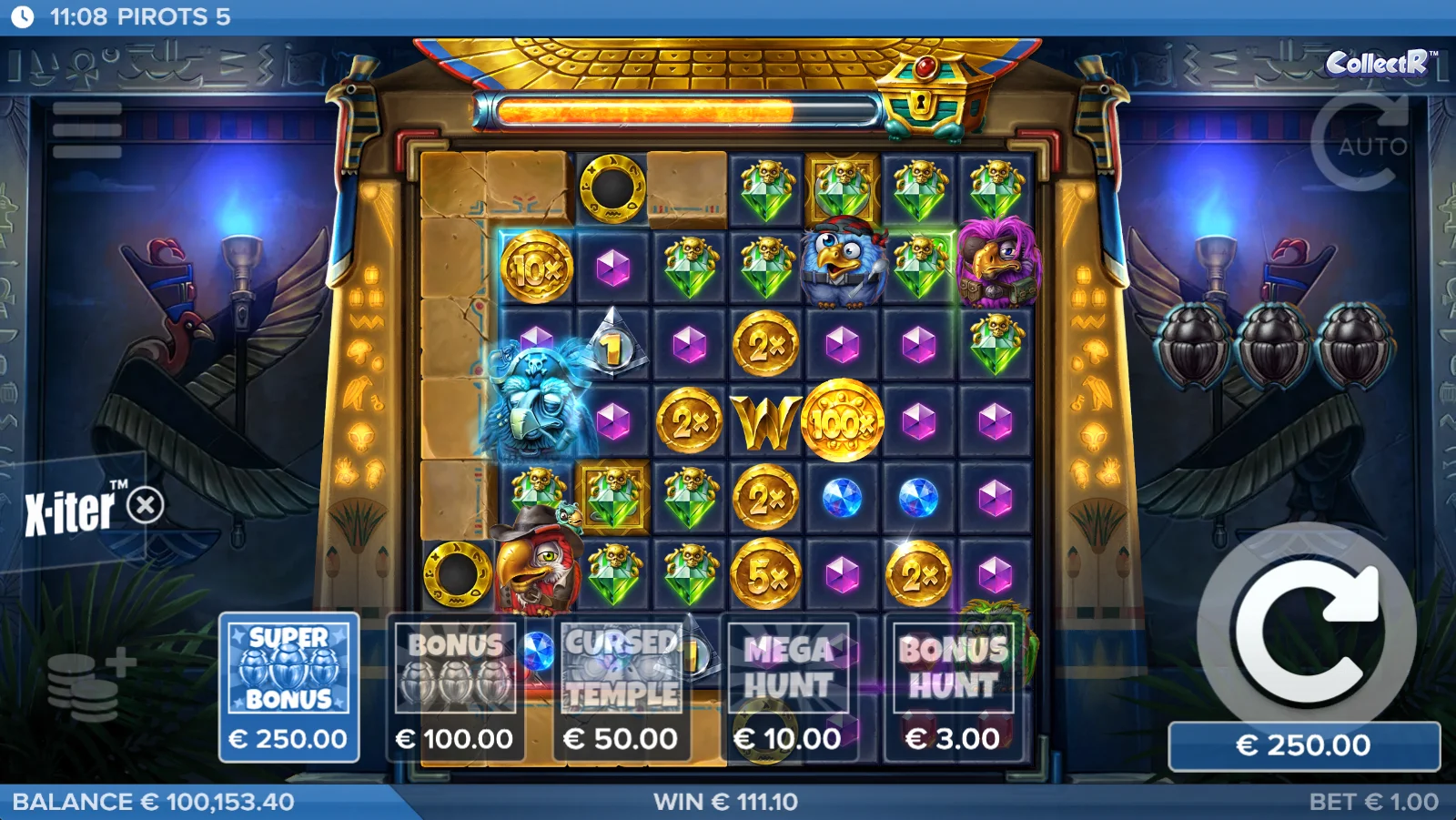
- Grid and collectors: follow matching colours and feature symbols.
- Selected mode: this picture highlights Super Bonus.
- Full charge: the selected purchase shows €250.
- Base stake: the bottom-right BET field shows €1.
- WIN: €111.10 is a displayed result, not the next purchase’s predicted return.
Keep the rule panel available while learning. Match a symbol to its explanation before attaching a numerical meaning to the animation.
Read a collector sequence in four steps
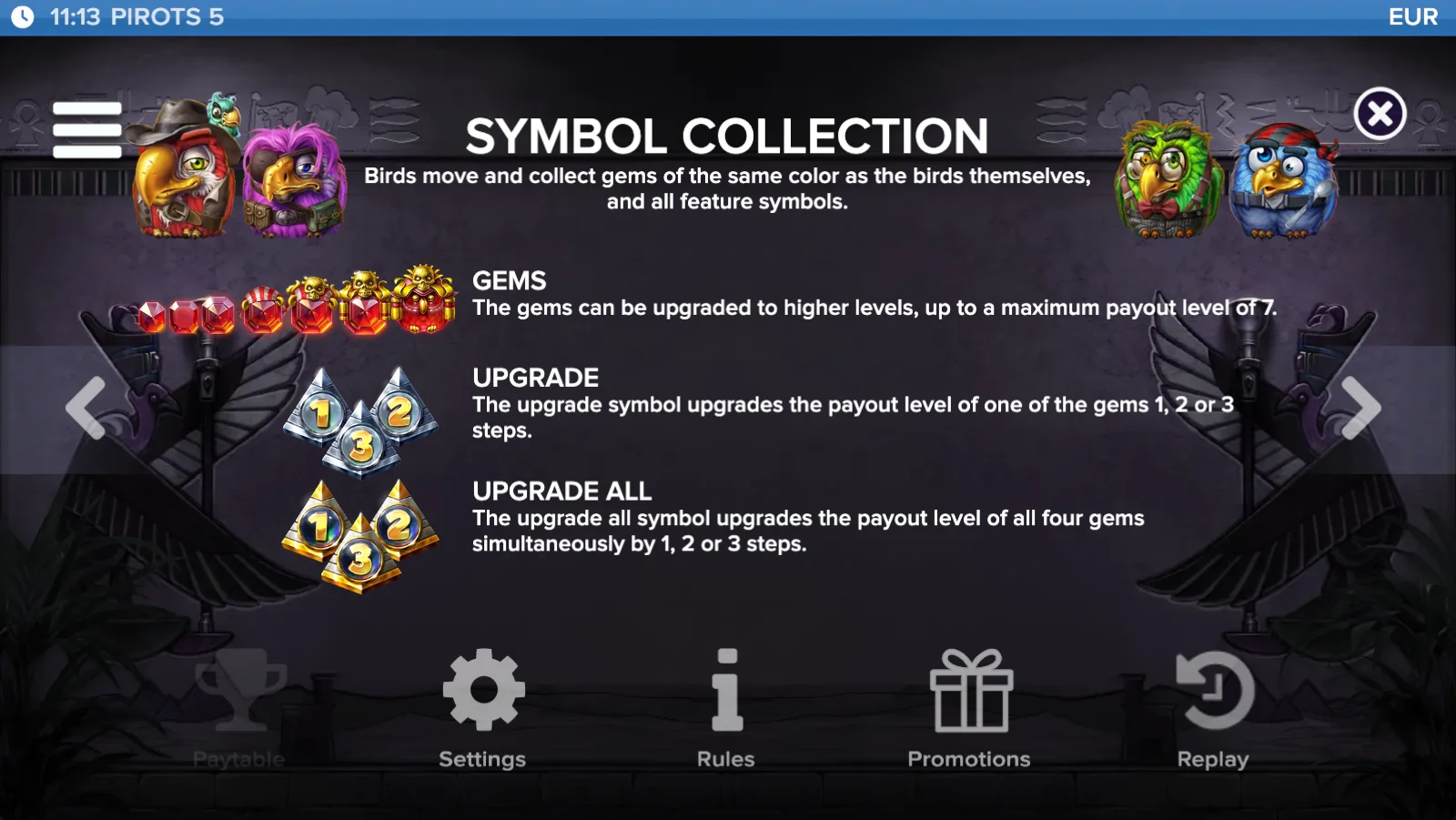
First, identify the bird and its matching gem colour. This is the starting relationship; nearby gems of another colour do not become collectable merely because they are close. Feature symbols are different: all four collectors can collect them. The distinction helps when a bird takes an unexpected route through an upgrade or another special symbol.
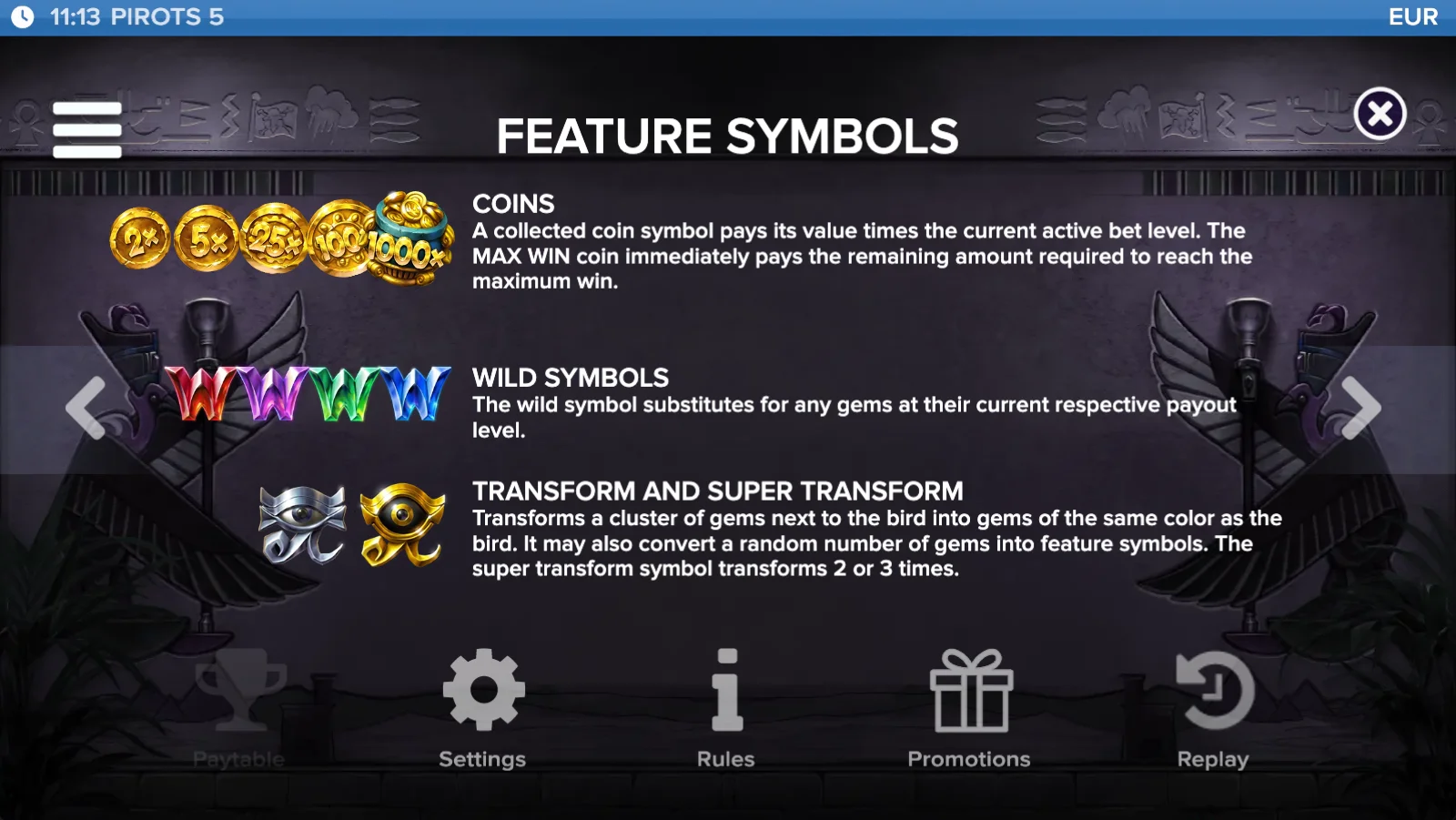
Second, watch what changes the board. Transform can change an adjacent gem cluster to the collecting bird’s colour. It may also turn some gems into feature symbols. Super Transform performs its transformation two or three times. A path which was blocked by a different colour can therefore become useful during the sequence, without the player changing any controls.
Third, check the gem level. The same gem colour does not keep one value throughout every feature. There are seven levels. An Upgrade raises one colour by one, two or three levels; Upgrade All applies a rise to all four colours. Reaching a higher level changes the relevant payout, but level seven is the documented ceiling. An upgrade animation does not imply that levels can rise indefinitely.
Fourth, wait for the award to finish. Do not add a coin’s face value, a changing win counter and a final total together if they represent overlapping stages of the same award. For a spending record, the useful figure is the complete amount credited after the paid round and any attached feature settle. If the client’s history splits those parts, retain their relationship rather than inventing extra stakes.
Imagine a blue bird, a blue cluster and an Upgrade. If the sequence collects the upgrade before later blue gems, the changed level matters when reading those later values. This is an explanatory example, not a reconstructed recorded round. It teaches where to look; it cannot tell you which sequence the next paid start will generate.
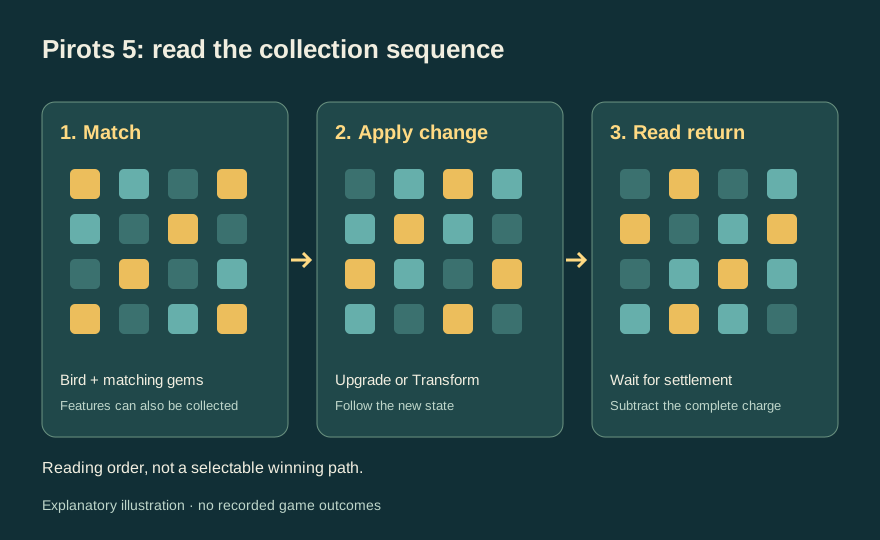
The diagram below deliberately separates a starting board, a rule-triggered change and a settled award. The arrows show the reading order. They do not represent probabilities or a selectable route. Pirots 5 is not a puzzle in which choosing the correct bird path guarantees the displayed payout. Learn the symbols so that you can understand a result, not because a drawn route predicts it.
Wilds, coins and the symbols that change value
A wild substitutes for gems at their respective current payout level. That last phrase matters. A wild is not a fixed cash prize independent of the level system. Read it in the context of the current game state, just as you would read an ordinary collected gem. Colour, level and the kind of award must stay connected.
Coins use a different presentation. Their face value is multiplied by the active bet level. You should therefore check the client’s paytable and current stake rather than treating a number on a promotional coin as a universal euro award. A MAX WIN coin pays the remaining amount up to the game’s win cap; it does not add another full maximum after everything already won.
Captain Blackfeather can transform one to four birds into ghosts. Their corresponding gems become Blackfeather gems. This explains why the special black payout ladder appears beside the four ordinary gem colours. It is a rule-driven change to collectors and gems, not evidence that the player has unlocked a permanent account upgrade.
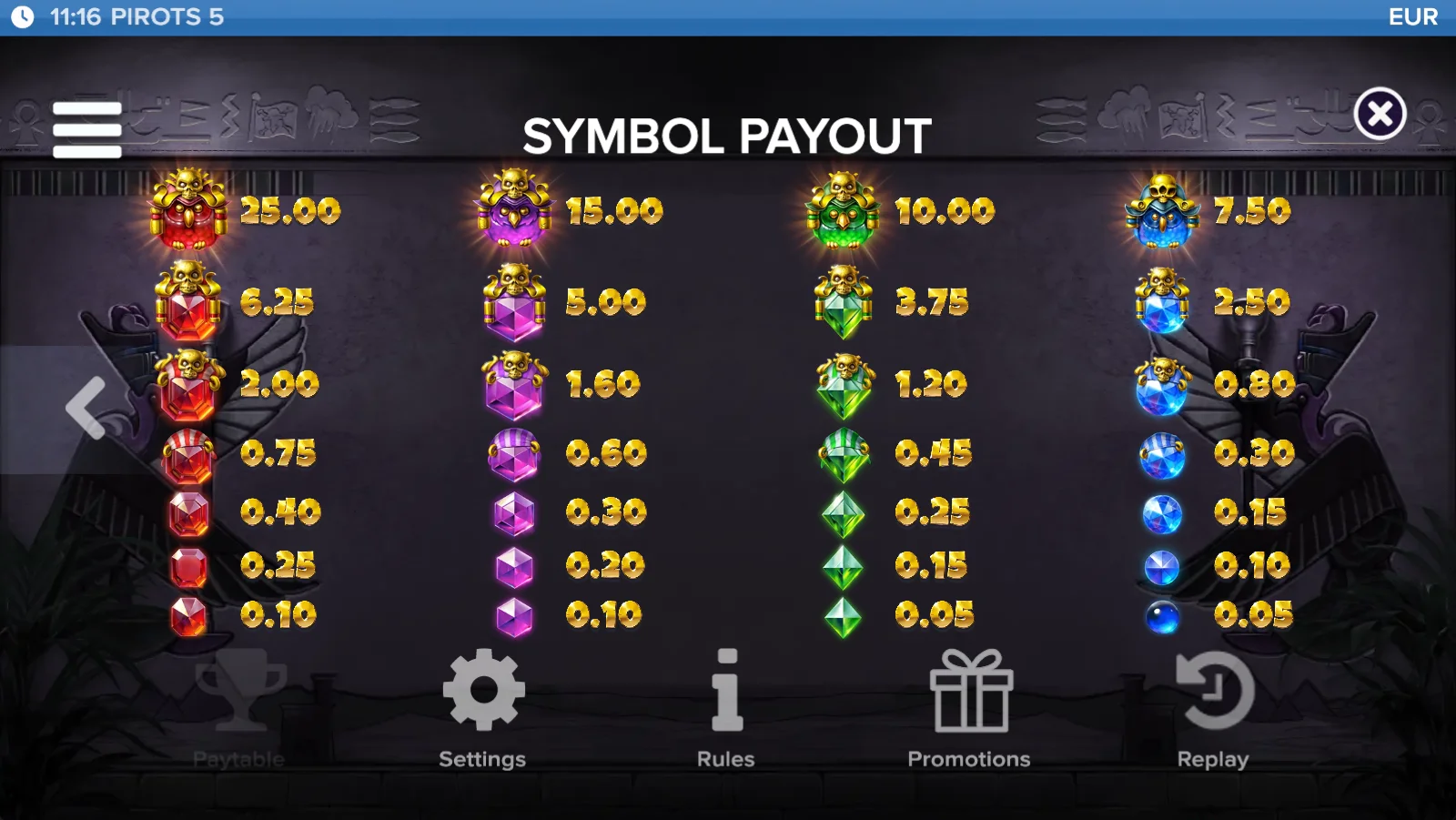
The official payout image shows seven levels for each ordinary colour. For example, its red column runs from €0.10 to €25, while the blue column runs from €0.05 to €7.50. Those are values displayed in that particular promotional panel. The base stake associated with the panel has not been verified, so we do not present them as fixed rewards or reusable payout coefficients for your own stake.
To read your own panel, check the active stake first, then the colour, then the level. A large number at the top of a ladder describes a conditional payout at that level. It is not the typical value of every gem and does not give the probability of reaching that level. Multiplying the largest visible number by every position on the grid would ignore the actual collection rules.
Keep ordinary returns separate from net profit. If a paid start costs €1 and returns €0.60, the screen has shown a return but your net result is −€0.40. If a €100 bonus purchase returns €60, the same principle produces −€40. A win animation can accompany a result that recovers only part of the amount charged.
Portals, catacombs and traps explain the strange moves
The board contains features that alter movement as well as value. Labyrinth removes gems from random rows or columns and moves birds along those routes until they are separated. A sudden change in position can therefore be part of the rule sequence. It does not mean the player clicked a hidden destination or selected a better-paying path.
Catacombs connect to coloured corners. Collecting a symbol on the matching-colour corner takes the bird into the catacombs. In the Cursed Temple material, defeating the mummy awards a feature symbol. The matching corner condition is important: seeing a corner and seeing a collector somewhere on the board are not, by themselves, a completed trigger.
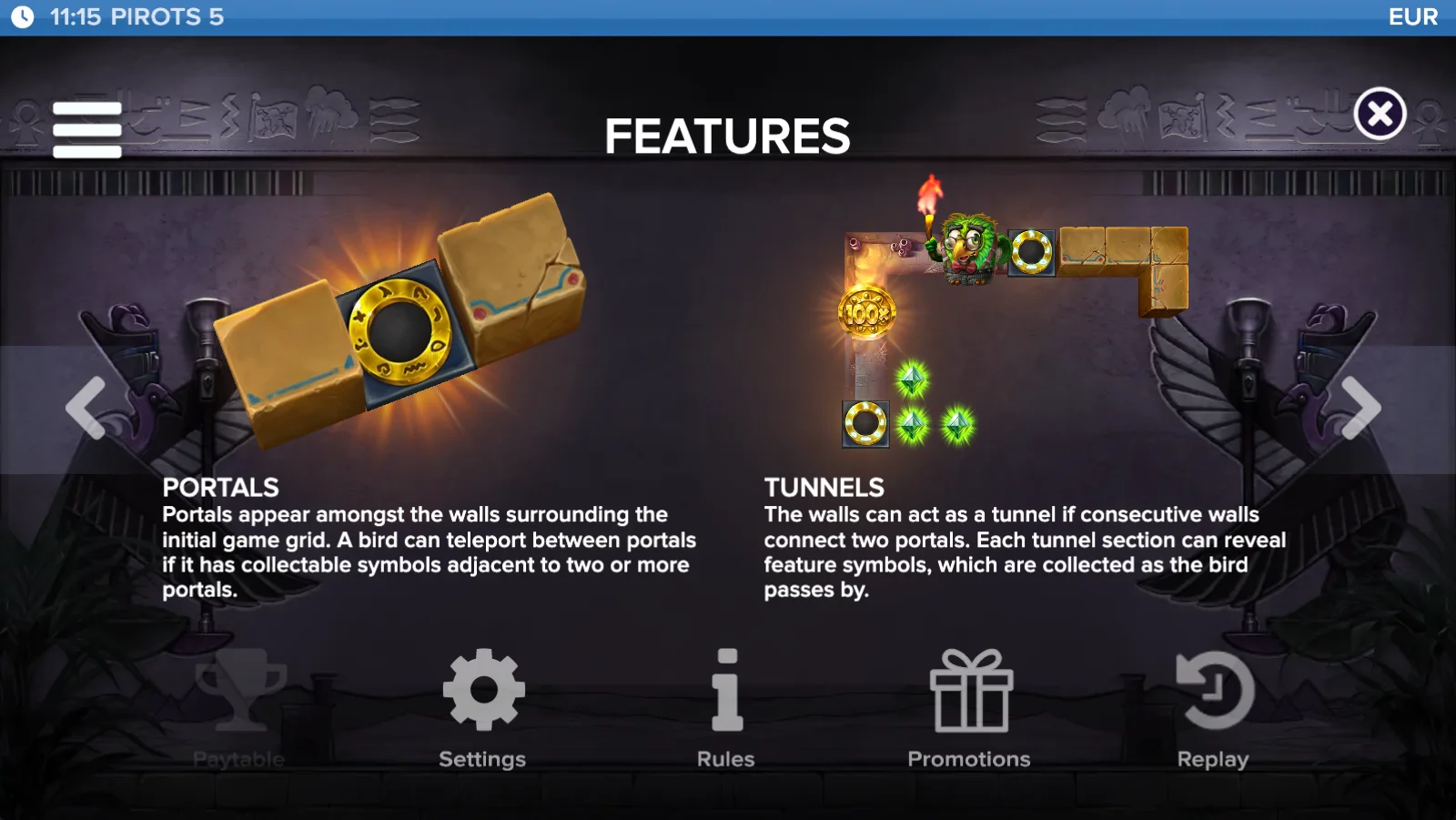
Portals sit on the border. A bird can teleport where collectable symbols adjoin at least two portals. Connected wall sections between portals form tunnels. A tunnel can reveal features that the bird collects while passing through. The visible board is therefore only part of what you need to follow when the route uses the edge.
Not every striking animation is an upgrade. An Arrow removes the bird it hits and changes that bird’s gems to another bird’s colour. A Boulder crushes gems, walls and birds in its path. These are distinct effects. Do not describe both as extra wilds or assign a direct cash award simply because a large object crosses the grid.
Secret Door rotates all the symbols and birds. Cross-over tiles then allow travel through positions that were already collected. That is why an apparently finished area can become relevant again. Clearing the entire grid during Secret Door triggers the Cursed Temple coin feature. The full-grid condition is stronger than merely seeing the door symbol.
You do not need to memorise every animation before a first demo visit. Use three questions: what moved, what changed colour or level, and what triggered a new phase? The illustrated Pirots 5 feature guide groups the answers. Its edition comparison also separates the mummy, land crab and shaman artwork, so a different temple enemy does not make you misread the underlying mode price.
Bonus entry and the three-drop coin feature
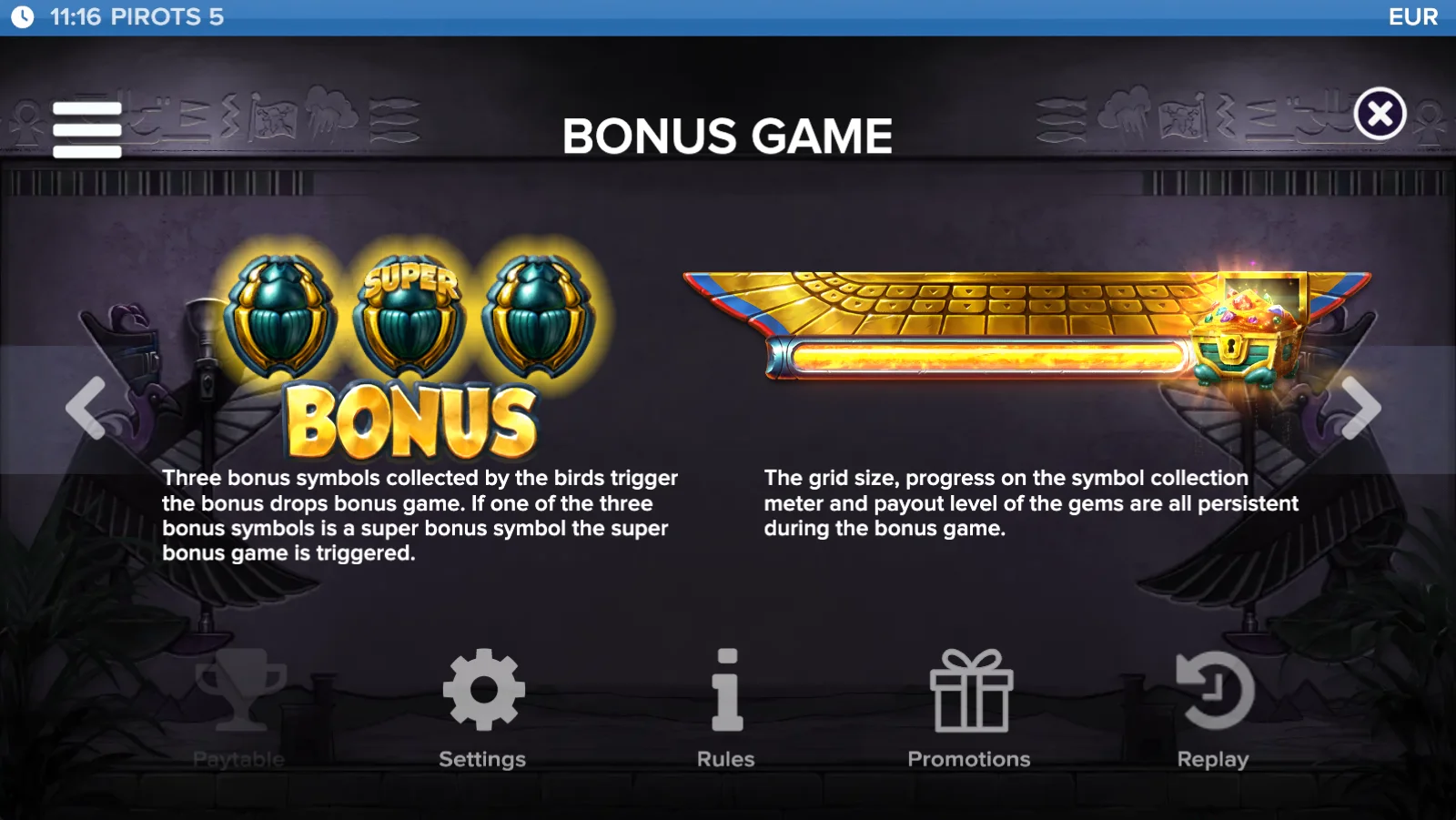
The regular bonus requires three collected bonus symbols. “Collected” is the useful word. Do not count every symbol that appears somewhere on the screen as already added to the trigger. If at least one of the three collected symbols is a Super Bonus symbol, the rules describe entry to Super Bonus instead.
The bonus preserves the grid size, collection-meter progress and gem payout levels within that bonus. Persistence is therefore part of the feature, but its scope is limited. These rules do not say that closing the game, changing operators or returning next week carries a stronger gem ladder into a new paid session. Avoid building a staking plan around progress that has not been documented as permanent.
Cursed Temple is a separate coin feature reached by the Secret Door clear condition or offered through the mode menu. It starts with three drops. Landing coins, birds or other eligible resetting symbols restores the counter. An empty sequence can use up the remaining drops; a resetting hit before the counter ends gives the feature more opportunities to continue.
For example, start at three, take two empty drops and you have one left. If the next drop produces a resetting hit, the counter returns to three. This is a rule example, not an estimate of how often that hit occurs. Three initial drops does not mean exactly three drops in every feature, and it does not establish a minimum payout.
Treasure can curse adjacent birds and produce coin rain in Cursed Temple. Super Bonus has its own advertised coin rain on every bonus drop. Those descriptions refer to feature behaviour, not to a promise that the complete payout exceeds the purchase price. A €250 entry still needs more than €250 returned to make a net profit at a €1 base stake.
The feature walkthrough includes a small counter you can operate manually. It helps you see why a reset and an extra paid spin are different events. It deliberately contains no random payouts. A teaching widget is not an official demo and cannot validate a strategy for the real game.
A useful first-session checklist
Before pressing spin, record the base stake, selected mode and full charge. After the complete result settles, record the total returned. Subtract the charge once. If you buy a feature, label it separately from ordinary base play. Mixing a €1 base spin and a €250 purchase into a single “average spin” hides the most important difference in exposure.
For a hypothetical €20 session budget, twenty €1 base starts use the whole allocation if nothing is returned and nothing is reused. A single €1-base Super Bonus costs €250, which is twelve and a half times that entire budget. These are cost comparisons, not suggested budgets or a claim that twenty starts are affordable for everyone. The mode-cost calculator lets you enter your own example.
The 6 November 2026 inspection opened the Cursed Temple board and Rules. No paid starts or settled rounds were recorded. The help states 96.0% RTP for that demo; an operator’s setting and local network access still require their own check.
If a round appears interrupted after a debit, use the actual game or operator history to resolve it before starting a spending comparison. A missing animation is not proof that the stake was refunded. Equally, reloading the page is not evidence that a second charge occurred. You need the recorded debit and settlement, not just the screen you happened to see.
The practical goal is modest: recognise the collector, understand what changed, and know what the attempt cost. That makes the game easier to read without pretending that observation controls the next outcome. For the mathematical distinction between a return, a winning bet and long-run RTP, continue to the Pirots 5 RTP and volatility guide.
A four-entry worksheet: one stake, different charges
Here is a complete arithmetic exercise you can repeat without opening the game. Every entry uses a €0.20 base stake, but the selected modes differ. These four returns are invented teaching values. They are not a selected winning sequence, a sample from ELK or a recommendation to buy the final feature.
Entry A is ordinary base play. Its €0.20 charge returns nothing, so the net is −€0.20. Entry B is also base play, returning €0.30 against €0.20 charged. Its net is +€0.10. Together, the two starts cost €0.40 and return €0.30; the pair is still down €0.10 even though the second entry was profitable.
Entry C switches to Bonus Hunt. Three times the €0.20 base stake means a €0.60 charge. Its illustrative €0.20 return is one whole base stake, but it recovers only a third of the actual cost. The net is −€0.40. This is the mistake the mode column catches: recovering the base-stake number is not enough to break even in a priced-up mode.
Entry D is a purchased Bonus at 100 base stakes. It costs €20 and returns an illustrative €12, leaving −€8. It is one paid start, but it accounts for most of the worksheet’s spending. Treating it as equivalent exposure to Entry A simply because both occupy one row would conceal that difference.
Swipe sideways if the table extends beyond the screen.
| Entry / mode | Charged | Returned | Net |
|---|---|---|---|
| A · Base | €0.20 | €0 | −€0.20 |
| B · Base | €0.20 | €0.30 | +€0.10 |
| C · Bonus Hunt | €0.60 | €0.20 | −€0.40 |
| D · Bonus | €20 | €12 | −€8 |
| Total | €21 | €12.50 | −€8.50 |
Adding the four complete charges gives €21. Adding the returns gives €12.50. Subtracting once leaves −€8.50. The same answer comes from summing the four signed net figures. If those two methods disagree in your own worksheet, check for a missing purchase cost, an unsettled feature or an intermediate win counted twice.
The invented worksheet has three positive returns and one individually profitable start. Neither count tells you the total financial result on its own. It is possible to have more paying entries than losing-to-zero entries and still finish down. That does not make the arithmetic mysterious; it means that return size and full cost matter alongside frequency.
For an actual record, replace the invented values with the client’s settled amounts and retain the mode. Keep a failed launch outside the table. Keep an unresolved debit in a separate pending state until its outcome can be checked. Do not replace a missing return with zero just to make a chart complete. A neat chart built from incomplete entries would be less useful than a short, correctly reconciled record.